XML Sitemaps in 2026: What Google Reads and What It Ignores
Ammar
AI Specialist
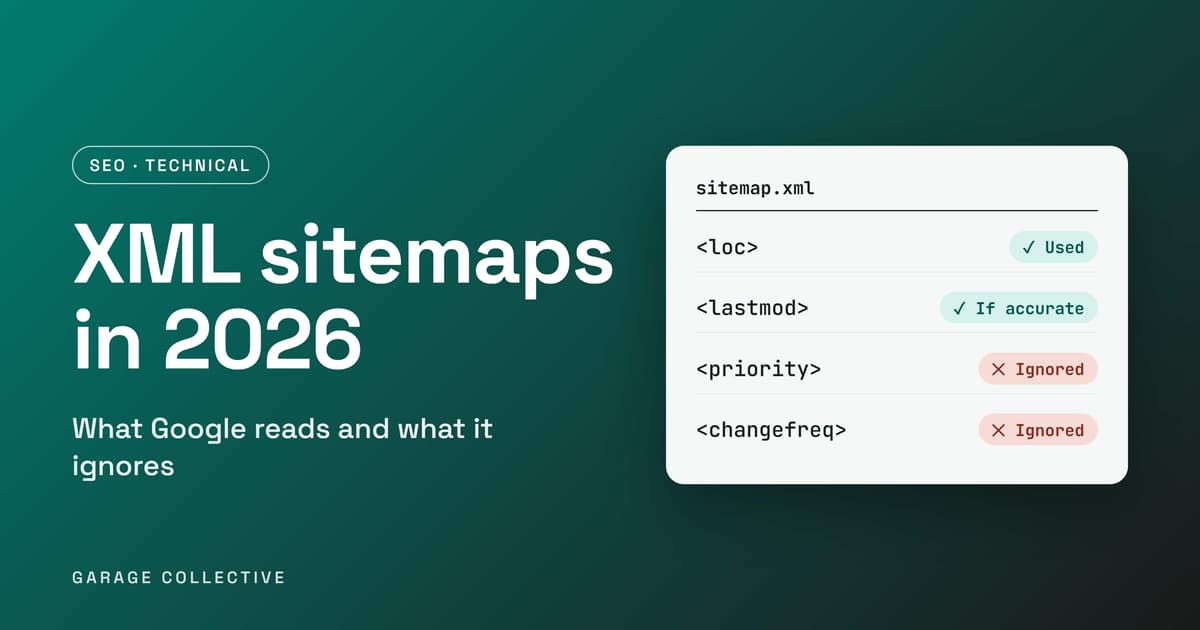
Plenty of sitemaps are full of tags Google throws away. Priority values nobody tuned, a changefreq of "daily" on a page last edited in 2022, and a lastmod date that updates every time the site rebuilds. Google's sitemap documentation is blunt about it: it ignores priority and changefreq, uses lastmod only when it is consistently and verifiably accurate, and treats the whole file as a hint, not a promise to crawl. This guide covers what a good sitemap actually contains, the limits you need to know, how to submit it, and a short audit you can run on your own file today.
A sitemap is a hint, not a promise
Google describes submitting a sitemap as merely a hint. It may not download the file or use it for crawling at all. A sitemap helps Google discover URLs, but it does not guarantee they get crawled or indexed, and it does not replace good internal links. Think of it as a tidy list of the pages you want found, not a lever you pull.
Pick a format
Google accepts three formats and has no preference among them.
| Format | Good for | Limits |
|---|---|---|
| XML | The most versatile. Supports image, video, news and localised-version extensions | None beyond the size limits |
| RSS 2.0, mRSS or Atom 1.0 | Easy if your CMS already generates a feed | Can describe videos but not images or news, and usually covers only recent URLs |
| Plain text | Tiny sites | One URL per line in a .txt file, URLs only |
Google's suggestion is to use a CMS-generated sitemap, build one by hand if you have a few dozen URLs or fewer, and automate it for larger sites.
Know the limits
One sitemap file can hold 50MB uncompressed or 50,000 URLs. Anything bigger has to be split. You can group the pieces in a sitemap index file and submit only the index, or submit several sitemaps and indexes. Splitting by section also lets you track performance per sitemap in Search Console. For example, one file for products, one for blog posts and one for category pages.
What belongs inside
The rules from Google's page are short:
• The file must be UTF-8 encoded.
• Use fully qualified absolute URLs. Google crawls the URLs exactly as written.
• List the canonical URLs you want to appear in results.
• Entity-escape the values inside tags, as in any XML file.
• For mobile and desktop versions of a page, list one version or annotate both.
Notice what is missing: no priority and no changefreq.
lastmod, priority and changefreq
This is the part most people get wrong.
| Tag | What Google does |
|---|---|
| priority | Ignores it |
| changefreq | Ignores it |
| lastmod | Uses it only if it is consistently and verifiably accurate, for example matching the page's real last modification |
Google says lastmod should reflect significant updates, such as changes to the main content, structured data or links. Changing the copyright year does not count. If your platform stamps every URL with today's date on each rebuild, the tag stops being trustworthy, so fix it or remove it.
Where to put it and how to submit it
A sitemap can be hosted anywhere, but unless you submit it through Search Console it only affects URLs under its parent directory. Google recommends placing it at the site root. You can submit it in three ways:
• The Sitemaps report in Search Console, which also shows when Googlebot fetched it and any errors.
• The Search Console API.
• A Sitemap: line in robots.txt. You can list as many as you need.
Sitemap: https://www.example.com/sitemap.xml
If you manage robots.txt rules for crawlers, our guide to robots.txt for AI crawlers covers the rest of your robots.txt file.
Extensions: images, video, news
XML sitemaps can carry image, video and news extensions, plus localised versions of pages. If you publish a lot of video, Google also accepts video information in an mRSS feed.
A 15-minute sitemap audit
• Open your sitemap and check it is at the site root, UTF-8 encoded and under 50,000 URLs and 50MB.
• Spot-check ten URLs. Each should be absolute and the canonical version of the page.
• Delete priority and changefreq tags if you have them. They do nothing for Google.
• Compare lastmod dates with real edit dates on five pages. If they do not match, fix the source or drop the tag.
• Open the Sitemaps report in Search Console. Confirm the file was fetched and read the errors.
• Confirm robots.txt carries a Sitemap: line.
If you are planning a bigger structural clean-up, our enterprise website architecture guide is a good companion read.
FAQ
Does Google use priority and changefreq?
No. Google ignores both tags, so you can safely remove them from your sitemap.
When does Google trust lastmod?
Only when it is consistently and verifiably accurate, for example when it matches the page's real last modification. It should reflect significant changes to main content, structured data or links, not a copyright-year change.
How big can a sitemap be?
Up to 50MB uncompressed or 50,000 URLs per file. For more, split it and submit a sitemap index.
Does a sitemap guarantee indexing?
No. Google calls submission a hint. It may not download the sitemap or use it for crawling.
How do I submit a sitemap?
Use the Sitemaps report in Search Console, the Search Console API, or a Sitemap line in robots.txt. Put the file at the site root so it covers the whole site.
Like what you're reading?
Get a free marketing plan tailored to your brand
Get Your Free Planyes, actually free. we're not kidding.
Key Takeaways
- A sitemap is a hint to Google, not a guarantee of crawling or indexing.
- Google ignores priority and changefreq, so delete them.
- Keep lastmod only if it is accurate and reflects real, significant changes.
- Respect the 50MB and 50,000 URL limits, and split big sites with a sitemap index.
- List absolute, canonical, UTF-8 URLs and submit through Search Console or a robots.txt Sitemap line.
the TL;DR your boss will love
This Isn't Just Theory. We Do This Daily.
Let us show you exactly what we'd do for your brand - strategy, channels, budget, timeline. Free. No pitch deck.
Get Smarter Every Week
Ideas, data, and the occasional hot take. Biweekly, no spam.
we promise not to sell your email to robots
You Might Also Dig These
^ we picked these just for you (okay, the algorithm did)
Google's October 2026 AI Content Guidance: SEO and E-E-A-T Checklist
Google updated its guidance on generative AI content on 1 October 2026, aligning the documentation more closely with its Search Quality Rater Guidelines. The update does not create a special ranking system for AI-written pages. It sharpens the standard that matters: content should serve a clear audience, demonstrate real expertise and make factual claims easy to verify. For Indian marketing teams using AI at scale, the operational question is no longer whether AI may be used. It is whether every published page adds original value, accountable authorship and dependable evidence.
ReadIndia Festive Commerce Playbook 2026: D2C, Quick Commerce and Always-On Growth
India’s festive season remains a major commercial opportunity, but e-commerce demand is no longer limited to a few sale events. NIQ describes a market shaped by both habitual purchases and event-driven peaks, while Meta points to video-first discovery, creators and messaging-led commerce. A useful festive plan connects demand forecasting, channel roles, creative and customer experience from discovery through repeat purchase.
ReadUltimate Guide to AI-First Agency Month: Optimize Performance Marketing ROI Amid Rising Ad Costs in India
Struggling to keep up with rising ad costs and ever-changing Google and Meta algorithms? Indian marketers, startups, and D2C brands are feeling the pressure to scale smarter - not harder. Ready to cut through the noise and supercharge your performance marketing ROI? This guide reveals AI-first strategies, proprietary tools, and proven tactics to help you stay ahead and win big in India’s digital market.
Read